Domain-Driven Design (DDD)
Info
At ConnectSoft, Domain-Driven Design (DDD) is not just a methodology —
it is a strategic foundation that powers scalable SaaS platforms, resilient AI ecosystems, microservices, and cloud-native systems.
🎯 Introduction to Domain-Driven Design
Domain-Driven Design (DDD) is an approach that focuses on modeling software according to the business domain it serves.
Originally introduced by Eric Evans in Domain-Driven Design: Tackling Complexity in the Heart of Software, DDD ensures that software solutions reflect real-world business needs, enabling systems to evolve alongside the businesses they support.
At ConnectSoft, DDD principles are integrated into every layer — from architecture design to AI-powered platforms — enabling the creation of resilient, flexible, and aligned solutions.
Key areas of DDD:
- Strategic Design:
- Defines clear boundaries through Bounded Contexts and Context Mapping to manage complexity at scale.
- Tactical Design:
- Builds expressive models using Entities, Value Objects, Aggregates, Repositories, Domain Events, and Specifications.
🖼️ Visual Overview: DDD in ConnectSoft
flowchart TD
    Strategy(Strategic Design) -->|Bounded Contexts| BoundedContexts
    BoundedContexts -->|Context Mapping| ContextMaps
    ContextMaps -->|Integration Patterns| AntiCorruptionLayer
    Strategy -->|Shared Language| UbiquitousLanguage

    Tactics(Tactical Design) -->|Entities, Value Objects, Aggregates, Enumerations| DomainModel
    DomainModel -->|Persistence Abstraction| Repositories
    DomainModel -->|Persistence Abstraction| Specifications
    DomainModel -->|State Changes| DomainEvents

    SaaSPlatform(SaaS, AI, Microservices) --> Strategy
SaaSPlatform --> Tactics✅ Strategic Design sets the boundaries, collaboration models, and relationships between domains and teams.
✅ Tactical Design implements the internal richness of each domain model with strong encapsulation and behavior-driven constructs.
💡 ConnectSoft’s Domain-Driven Design Approach
-
Business-Centric Modeling
Systems mirror the business language, concepts, and workflows precisely. -
Bounded Context Isolation
Each microservice defines and enforces its domain boundaries independently, reducing coupling and promoting agility. -
Cloud-Native and Event-Driven Architecture
Domain Events drive asynchronous communication, real-time reactions, and resilient scaling. -
Strategic Evolvability
Context Maps, Anti-Corruption Layers, and clear integration points allow seamless domain evolution without breaking existing contracts. -
Domain-Centric AI Enablement
ConnectSoft’s AI solutions reason over domain-accurate data and models, enhancing decision-making and automation capabilities.
🧠 Core Values of Domain-Driven Systems at ConnectSoft
-
Truth over Technology
Focus on faithfully modeling business rules rather than optimizing for technical frameworks or databases. -
Unified Language Everywhere
The ubiquitous language defines conversations, code, documentation, and interfaces — creating true organizational alignment. -
Explicit Boundaries and Ownership
Every domain, service, and integration is clearly bounded, with enforced ownership and change control. -
Behavioral Richness Inside Models
Entities, Aggregates, and Value Objects encapsulate behavior, not just data, ensuring consistent rule enforcement. -
Designed for Change
Evolution is natural: models, services, and teams grow with minimal friction thanks to DDD’s separation and autonomy.
🌟 Why DDD Is Essential at ConnectSoft
- Faster Alignment Across Teams
- Reduced Technical Debt Over Time
- Clearer Business-Technology Collaboration
- Resilient Microservice Ecosystems
- Smarter, Context-Aware AI Integrations
- True Cloud-Native Scale and Flexibility
Strategic vs Tactical Design
Domain-Driven Design (DDD) focuses on creating software that accurately models complex business domains.
By tightly aligning technical implementations with business realities, DDD enables systems to remain flexible, scalable, and adaptable even as business needs change.
At ConnectSoft, DDD is embraced not only for technical excellence but to ensure that every SaaS solution, AI-powered engine, or cloud-native microservice remains tightly coupled to the business strategies they empower.
Key foundational pillars of DDD include:
- Modeling the Core Domain: Focus development around the most critical business concepts.
- Isolating Boundaries: Define clear bounded contexts for independent evolution.
- Ubiquitous Language: Use a shared language across all teams — in conversations, documentation, APIs, and code.
Strategic Design
Strategic design in DDD addresses how large, complex systems are organized.
It focuses on identifying meaningful boundaries between subsystems and managing interactions between different parts of the business and software architecture.
Key strategic patterns include:
-
Bounded Contexts
Clearly delineated areas where a specific model applies consistently.
Each bounded context defines its own language, rules, and data representations. -
Context Mapping
Visualizes how different bounded contexts relate to each other, including their communication contracts and integration patterns. -
Anti-Corruption Layers
Prevents the influence of external models from corrupting internal domain models by mediating communications. -
Customer-Supplier Relationships
Manages dependencies where one bounded context supplies functionality to another.
Strategic design ensures that different parts of the system can evolve independently, scale separately, and collaborate without accidental coupling.
Tactical Design
Tactical design focuses on building the internals of a bounded context:
modeling the entities, value objects, aggregates, and domain events that express the domain's behavior and rules.
Key tactical patterns include:
-
Entities
Objects with unique identity and lifecycle (e.g., Customer, Order, Account). -
Value Objects
Descriptive aspects of the domain without identity (e.g., Address, Money). -
Aggregates and Aggregate Roots
Groups of domain objects treated as a single unit of consistency. -
Domain Services
Stateless services coordinating behavior that spans multiple aggregates. -
Repositories
Abstractions for retrieving and persisting aggregates without leaking infrastructure concerns. -
Specifications
Reusable business rule definitions used for validation and querying.
Tactical patterns ensure that models remain expressive, testable, resilient to change, and encapsulate domain behavior rather than merely acting as data containers.
🎯 ConnectSoft Strategic and Tactical Synthesis
At ConnectSoft:
-
Bounded Contexts map to Business Capabilities
Every microservice owns its domain language, models, and contracts, allowing true autonomy. -
Rich Internal Models Drive Behavior
Aggregates, Entities, and Value Objects encapsulate business invariants — minimizing bugs and unexpected states. -
Events Communicate Changes Across Contexts
Systems integrate asynchronously through published domain events, achieving eventual consistency and high resilience. -
Boundaries Are Protected Relentlessly
Anti-Corruption Layers safeguard ConnectSoft domains from legacy systems or third-party models. -
Evolution Happens by Design
Clear strategic boundaries + clean tactical models = continuous, safe evolution at scale.
🧩 Diagram: DDD Strategic and Tactical Layering
flowchart TB
    subgraph StrategicDesign
        BC(Bounded Contexts)
        CM(Context Maps)
        ACL(Anti-Corruption Layers)
    end

    subgraph TacticalDesign
        E(Entities)
        VO(Value Objects)
        AG(Aggregates)
        EN(Enumerations)
        RE(Repositories)
        SP(Specifications)
        DS(Domain Services)
        DE(Domain Events)
    end

    SaaSPlatform(SaaS, AI, Microservices) --> StrategicDesign
SaaSPlatform --> TacticalDesignUbiquitous Language
A Ubiquitous Language is a central principle of Domain-Driven Design (DDD).
It is a shared, precise, and evolving language used by developers, domain experts, and stakeholders to describe all aspects of the domain, from conversations to code.
At ConnectSoft, the Ubiquitous Language is embedded deeply across projects —
ensuring that business, technology, and AI models speak the same language.
🎯 Concept Definition
A Ubiquitous Language:
-
Is Shared:
All team members — technical and non-technical — use the same terms consistently. -
Is Embedded in Code:
Class names, method names, APIs, events, and documentation reflect the language precisely. -
Is Evolving:
As new insights emerge, the language — and the models — are updated collaboratively. -
Is Bounded:
Each Bounded Context has its own Ubiquitous Language to prevent cross-domain confusion.
Why It Matters at ConnectSoft
-
Bridges Business and Technology
Domain experts and engineers collaborate using a consistent, living language. -
Eliminates Ambiguities
Critical terms (e.g.,Order,Account,Patient) have precise meanings. -
Drives Accurate Models
Systems that model the domain truthfully are more resilient and easier to evolve. -
Empowers AI and Automation
AI models built on domain-aligned concepts produce better predictions, workflows, and insights. -
Improves Developer Onboarding
New team members can reason about systems faster by learning the ubiquitous language.
📚 Practical Guidelines
✅ Consistency
- Always use the same terms across meetings, documentation, APIs, and code.
✅ Code as Living Language
- Ensure domain terms appear in class, method, event, and property names directly.
✅ Collaborative Refinement
- Involve domain experts in shaping and evolving the language continuously.
✅ No Silent Drift
- Any update in business understanding should result in updates to models, documentation, and code.
✅ Respect Bounded Contexts
- Do not force one bounded context’s language onto another; honor their autonomy.
🧩 C# Example: Ubiquitous Language Reflected in Code
public class Order
{
    public Guid OrderId { get; private set; }
    public Customer Customer { get; private set; }
    public DateTime OrderDate { get; private set; }
    public List<OrderItem> Items { get; private set; }

    public Order(Guid orderId, Customer customer)
    {
        OrderId = orderId;
        Customer = customer ?? throw new ArgumentNullException(nameof(customer));
        OrderDate = DateTime.UtcNow;
        Items = new List<OrderItem>();
    }

    public void AddItem(Product product, int quantity)
    {
        Items.Add(new OrderItem(product, quantity));
    }
}

public class Customer
{
    public Guid CustomerId { get; private set; }
    public string FullName { get; private set; }

    public Customer(Guid customerId, string fullName)
    {
        CustomerId = customerId;
        FullName = fullName ?? throw new ArgumentNullException(nameof(fullName));
    }
}

public class OrderItem
{
    public Product Product { get; private set; }
    public int Quantity { get; private set; }

    public OrderItem(Product product, int quantity)
    {
        Product = product ?? throw new ArgumentNullException(nameof(product));
        Quantity = quantity;
    }
}
✅ Terms like Order, Customer, and OrderItem are used consistently across domain discussions, documents, and code.
✅ No technical or generic names like "DataObject" or "Record" dilute the business meaning.
🌍 Real-World Examples
- Healthcare Platform
- Terms:
Patient,Appointment,Diagnosis - Example: A
Patientschedules anAppointmentthat results in aDiagnosis.
- Terms:
graph TD
    Patient -->|Schedules| Appointment
Appointment -->|Results in| Diagnosis- E-Commerce Platform
- Terms:
Customer,Order,Product,Cart - Example: A
Customeradds aProductto theirCartand places anOrder.
- Terms:
graph TD
    Customer -->|Adds| Product
Customer -->|Places| Order- Finance Application
- Terms:
Account,Transaction,Balance - Example: A
Transactionis recorded for anAccount, updating itsBalance.
- Terms:
graph TD
    Account -->|Records| Transaction
Transaction -->|Updates| Balance✅ Best Practices Summary
| Best Practice | Description |
|---|---|
| Use it Everywhere | In code, conversations, UI labels, documentation, and APIs. |
| Collaborate | Build the language with domain experts, not just developers. |
| Reflect in Code | Every important domain term must appear naturally in the codebase. |
| Update Continuously | As domain understanding evolves, so must the language and model. |
| Respect Context Boundaries | Avoid forcing a shared language where separate meanings exist. |
Bounded Contexts
A Bounded Context is a central strategic pattern in Domain-Driven Design (DDD).
It defines a clear, explicit boundary within which a particular domain model is valid and consistent.
At ConnectSoft, Bounded Contexts are critical for managing complexity, enabling independent team autonomy, and ensuring that models, language, and rules remain pure within their domains.
🎯 Concept Definition
A Bounded Context:
-
Defines the Scope of a Model
Inside the boundary, a model has consistent meaning and behavior. -
Protects Domain Integrity
Prevents outside influences and mismatches from corrupting the model. -
Establishes Clear Interfaces
Bounded Contexts communicate externally through well-defined APIs, events, or anti-corruption layers. -
Supports Organizational Structure
Different teams own and evolve bounded contexts independently.
Why Bounded Contexts Matter at ConnectSoft
-
Scalability and Independence
Microservices map to Bounded Contexts, allowing teams to scale and deploy independently. -
Explicit Language Ownership
Each context evolves its own ubiquitous language without fear of term conflicts. -
Integration Clarity
Context Maps visualize relationships, agreements, and integration strategies between contexts. -
Strategic Control over Change
ConnectSoft evolves specific parts of its platform without destabilizing others — because boundaries are clear and respected.
📚 Key Guidelines
✅ Define Explicit Boundaries
- Each model is valid only within its own context.
✅ Communicate via Contracts
- APIs, events, and anti-corruption layers mediate communication between contexts.
✅ Align with Business Processes
- Bounded Contexts mirror real business capabilities and team structures.
✅ Preserve Model Purity
- No leaking of external models into internal domains.
✅ Allow Divergence
- Different bounded contexts can model the same concept differently if needed (e.g., "Order" in CRM vs "Order" in Fulfillment).
🛠️ C# Example: Separate Models per Bounded Context
// Order Management Context
public class Order
{
    public Guid OrderId { get; private set; }
    public List<OrderItem> Items { get; private set; }

    public Order(Guid orderId)
    {
        OrderId = orderId;
        Items = new List<OrderItem>();
    }

    public void AddItem(OrderItem item)
    {
        Items.Add(item);
    }
}

// Inventory Management Context
public class InventoryItem
{
    public Guid ProductId { get; private set; }
    public int StockQuantity { get; private set; }

    public InventoryItem(Guid productId, int stockQuantity)
    {
        ProductId = productId;
        StockQuantity = stockQuantity;
    }

    public void ReserveStock(int quantity)
    {
        if (quantity > StockQuantity)
            throw new InvalidOperationException("Insufficient stock.");
        StockQuantity -= quantity;
    }
}
✅ Order Management defines its own Order and OrderItem.
✅ Inventory Management defines InventoryItem — separately, even though both involve products.
🧩 Real-World ConnectSoft Examples
- Healthcare Platform
- Bounded Contexts:
Patient ManagementAppointment SchedulingBilling
- Bounded Contexts:
graph TD
    PatientManagement -->|PatientAdmitted Event| Billing
PatientManagement -->|ScheduleAppointment API| AppointmentScheduling- E-Commerce Platform
- Bounded Contexts:
Order ManagementInventory ManagementCustomer Management
- Bounded Contexts:
graph TD
    OrderManagement -->|OrderPlaced Event| InventoryManagement
OrderManagement -->|Customer API| CustomerManagement- Finance Platform
- Bounded Contexts:
Account ManagementTransaction ProcessingFraud Detection
- Bounded Contexts:
graph TD
    AccountManagement -->|TransactionCreated Event| FraudDetection
AccountManagement -->|ProcessTransaction API| TransactionProcessing🎯 Best Practices for Bounded Contexts
| Best Practice | Description |
|---|---|
| Name Contexts Clearly | Reflect domain language and responsibilities precisely. |
| Communicate Explicitly | Use contracts — APIs, Events, ACLs — not implicit data sharing. |
| Respect Autonomy | Avoid sharing models across contexts; duplication is acceptable if meanings differ. |
| Visualize Context Maps | Keep a living map of context relationships. |
| Organize Teams by Context | Assign team ownership aligned with bounded contexts for true autonomy. |
Entities
An Entity represents a uniquely identifiable object within the domain.
An entity is distinguished by its identity — not by its attributes. Even if two entities have identical attribute values, they are considered distinct if their identities differ.
At ConnectSoft, entities form the backbone of domain models across SaaS, finance, healthcare, and e-commerce platforms.
🎯 Concept Definition
An Entity:
-
Has a Unique Identity
Defined typically by a system-generated ID (e.g., GUID). -
Has a Lifecycle
Entities can change state over time while maintaining the same identity. -
Encapsulates State and Behavior
Domain-specific rules and business logic are included within the entity.
📚 Key Guidelines for Entities
✅ Immutable Identity
- Once assigned, an entity’s ID never changes.
✅ Behavior Inside the Entity
- Keep domain-specific behavior close to the data it operates on.
✅ Equality by Identity
- Entities are compared by identity, not by attribute values.
✅ Encapsulate State Changes
- Modify internal data only via behavior that enforces business rules.
✅ Reference Other Entities by ID
- Avoid object references across aggregates — use IDs.
🛠️ C# Example: Customer Entity
public class Customer
{
    public Guid CustomerId { get; private set; }
    public string FullName { get; private set; }
    public string Email { get; private set; }

    public Customer(Guid customerId, string fullName, string email)
    {
        CustomerId = customerId;
        FullName = fullName ?? throw new ArgumentNullException(nameof(fullName));
        Email = email ?? throw new ArgumentNullException(nameof(email));
    }

    public void UpdateEmail(string newEmail)
    {
        if (string.IsNullOrWhiteSpace(newEmail))
            throw new ArgumentException("Email cannot be empty.", nameof(newEmail));

        Email = newEmail;
    }
}
✅ CustomerId uniquely identifies the Customer.
✅ Changing the email preserves identity — it's still the same customer.
Real-World ConnectSoft Examples of Entities
-
Healthcare
- Entity:
Patient - Attributes:
PatientId,Name,DateOfBirth - Behavior: Schedule appointments, manage medical records.
- Entity:
-
E-Commerce
- Entity:
Order - Attributes:
OrderId,CustomerId,OrderItems - Behavior: Add items, cancel order, calculate total price.
- Entity:
-
Finance
- Entity:
BankAccount - Attributes:
AccountId,Balance - Behavior: Deposit money, withdraw funds, freeze account.
- Entity:
graph TD
    Patient -->|Schedules| Appointment
    Order -->|Contains| OrderItem
BankAccount -->|Records| TransactionValue Objects
A Value Object represents a descriptive aspect of the domain, defined only by its attributes.
Value Objects are immutable and interchangeable if all their attributes are the same.
At ConnectSoft, Value Objects are used extensively for precise, secure, and reliable domain modeling across systems.
🎯 Concept Definition
A Value Object:
-
No Identity
Uniqueness is based entirely on its attribute values. -
Immutability
Once created, a value object cannot change. New instances must be created for updates. -
Behavior with State
Encapsulates related behavior, not just raw data.
📚 Key Guidelines for Value Objects
✅ Immutable State
- No setters after creation. Validate in constructor.
✅ Equality by Attributes
- Two value objects are equal if all attributes match.
✅ Model Real-World Concepts
- Money, Address, Dates, Ranges, Coordinates, etc.
✅ Encapsulate Related Behavior
- Aggregate relevant domain logic inside the value object itself.
🛠️ C# Example: Money Value Object
public class Money
{
    public decimal Amount { get; }
    public string Currency { get; }

    public Money(decimal amount, string currency)
    {
        if (amount < 0)
            throw new ArgumentException("Amount must be non-negative.", nameof(amount));
        if (string.IsNullOrWhiteSpace(currency))
            throw new ArgumentException("Currency is required.", nameof(currency));

        Amount = amount;
        Currency = currency.ToUpperInvariant();
    }

    public Money Add(Money other)
    {
        if (Currency != other.Currency)
            throw new InvalidOperationException("Cannot add money in different currencies.");

        return new Money(Amount + other.Amount, Currency);
    }

    public override bool Equals(object obj)
    {
        if (obj is not Money other) return false;
        return Amount == other.Amount && Currency == other.Currency;
    }

    public override int GetHashCode() => HashCode.Combine(Amount, Currency);
}
✅ Money encapsulates validation, state, and behavior (like adding amounts).
✅ Different Money instances are equal only if both amount and currency match.
Real-World ConnectSoft Examples of Value Objects
-
E-Commerce
- Value Object:
Address - Fields:
Street,City,PostalCode,Country - Behavior: Full address formatting, validation.
- Value Object:
-
Finance
- Value Object:
CurrencyAmount - Fields:
Amount,Currency - Behavior: Currency conversions, arithmetic operations.
- Value Object:
-
Healthcare
- Value Object:
DateRange - Fields:
StartDate,EndDate - Behavior: Validate overlaps, compute durations.
- Value Object:
graph TD
    Customer -->|Has| Address
    Appointment -->|ScheduledWithin| DateRange
Transaction -->|Involves| CurrencyAmount✅ Best Practices Summary
| Best Practice | Entities | Value Objects |
|---|---|---|
| Has Identity | ✅ | ❌ |
| Immutable Identity | ✅ | N/A |
| Encapsulates Behavior | ✅ | ✅ |
| State Mutability | Mutable State | Immutable State |
| Comparison Rule | Compare by ID | Compare by Attributes |
| Use Case | Core domain concepts (e.g., Customer, Order) | Descriptive domain aspects (e.g., Address, Money) |
Aggregates
An Aggregate is a cluster of domain objects that form a consistency boundary.
An Aggregate Root is the single entry point to modify the aggregate and enforce all invariants.
At ConnectSoft, Aggregates ensure that business rules are consistently applied and transactions remain focused and lightweight.
🎯 Concept Definition
An Aggregate:
-
Defines a Consistency Boundary
Changes within the aggregate must preserve domain invariants. -
Has an Aggregate Root
Only the root entity is accessible to external clients. Child entities are managed internally. -
Enforces Invariants
Any change to an aggregate must validate and enforce business rules. -
Manages Lifecycle
The root controls creation, modification, and deletion of its children.
📚 Key Guidelines for Aggregates
✅ Small and Cohesive
- Keep aggregates small enough to ensure transactional consistency without performance bottlenecks.
✅ Reference by ID
- Refer to other aggregates using their IDs instead of object references.
✅ Single Transactional Boundary
- All changes to an aggregate should be saved atomically.
✅ Encapsulate Business Logic
- All invariant rules and complex operations happen inside the aggregate root.
✅ Protect Internal Structure
- Only expose necessary behavior through the aggregate root.
🛠️ C# Example: Order Aggregate Root
public class Order
{
    private readonly List<OrderItem> _items = new();

    public Guid Id { get; private set; }
    public DateTime OrderDate { get; private set; }
    public IReadOnlyCollection<OrderItem> Items => _items.AsReadOnly();

    public Order(Guid id)
    {
        Id = id;
        OrderDate = DateTime.UtcNow;
    }

    public void AddItem(Product product, int quantity)
    {
        if (quantity <= 0)
            throw new ArgumentException("Quantity must be greater than zero.");

        var existingItem = _items.FirstOrDefault(i => i.Product.Id == product.Id);
        if (existingItem != null)
        {
            existingItem.IncreaseQuantity(quantity);
        }
        else
        {
            _items.Add(new OrderItem(product, quantity));
        }
    }

    public decimal CalculateTotalPrice()
    {
        return _items.Sum(item => item.TotalPrice);
    }
}

public class OrderItem
{
    public Product Product { get; }
    public int Quantity { get; private set; }

    public OrderItem(Product product, int quantity)
    {
        Product = product ?? throw new ArgumentNullException(nameof(product));
        Quantity = quantity;
    }

    public void IncreaseQuantity(int quantity)
    {
        if (quantity <= 0)
            throw new ArgumentException("Quantity must be positive.");

        Quantity += quantity;
    }

    public decimal TotalPrice => Product.Price * Quantity;
}
✅ Order acts as the Aggregate Root.
✅ OrderItem instances are modified only through Order methods.
🧩 Real-World ConnectSoft Aggregate Examples
-
Healthcare
- Aggregate Root:
Patient - Child Entities:
Appointment,MedicalRecord
- Aggregate Root:
-
E-Commerce
- Aggregate Root:
Order - Child Entities:
OrderItem,Payment
- Aggregate Root:
-
Finance
- Aggregate Root:
BankAccount - Child Entities:
Transaction
- Aggregate Root:
graph TD
    Patient -->|Schedules| Appointment
    Patient -->|Owns| MedicalRecord
    Order -->|Contains| OrderItem
BankAccount -->|Records| TransactionRepositories
A Repository is a pattern that provides a collection-like interface for accessing aggregates.
It hides the underlying persistence mechanisms and allows the domain to remain pure and persistence-agnostic.
At ConnectSoft, repositories are essential for achieving clean separation between domain logic and data access infrastructure.
🎯 Concept Definition
A Repository:
-
Acts as a Gateway
Provides operations to add, retrieve, update, and delete aggregates. -
Encapsulates Persistence Details
Hides ORM/database concerns from the domain layer. -
Works at Aggregate Root Level
Operations target aggregates, not individual child entities. -
Respects Transactional Boundaries
One repository = one aggregate = one transactional consistency unit.
📚 Key Guidelines for Repositories
✅ Aggregate-Level Operations
- Only expose methods to manipulate entire aggregates.
✅ No Persistence Leakage
- Do not expose database constructs (like DbContext, raw queries) to domain models.
✅ CRUD as Needed
- Support Create, Retrieve, Update, Delete — but focus on use case needs, not generic data access.
✅ Persistence-Agnostic Design
- Domain layer should remain unaware of specific storage technology.
✅ Unit of Work Integration
- Repositories typically work within a Unit of Work pattern for transactional consistency.
🛠️ C# Example: Order Repository
public interface IOrderRepository
{
    void Add(Order order);
    Order GetById(Guid orderId);
    void Update(Order order);
    void Delete(Guid orderId);
}

public class OrderRepository : IOrderRepository
{
    private readonly DbContext _dbContext;

    public OrderRepository(DbContext dbContext)
    {
        _dbContext = dbContext;
    }

    public void Add(Order order)
    {
        _dbContext.Set<Order>().Add(order);
    }

    public Order GetById(Guid orderId)
    {
        return _dbContext.Set<Order>()
                         .Include(o => o.Items)
                         .FirstOrDefault(o => o.Id == orderId);
    }

    public void Update(Order order)
    {
        _dbContext.Set<Order>().Update(order);
    }

    public void Delete(Guid orderId)
    {
        var order = GetById(orderId);
        if (order != null)
        {
            _dbContext.Set<Order>().Remove(order);
        }
    }
}
✅ OrderRepository works only with Order aggregates.
✅ The domain layer depends only on the IOrderRepository abstraction.
🧩 ConnectSoft Repository Usage Examples
-
Healthcare
PatientRepositoryfor managingPatientaggregates.
-
E-Commerce
OrderRepositoryfor managingOrderand related items.
-
Finance
AccountRepositoryfor managingBankAccountaggregates.
graph TD
    PatientRepository -->|Handles| Patient
    OrderRepository -->|Handles| Order
AccountRepository -->|Handles| BankAccount✅ Best Practices Summary
| Best Practice | Aggregates | Repositories |
|---|---|---|
| Encapsulate Domain Rules | ✅ | ❌ |
| Enforce Consistency | ✅ | ❌ |
| Persistence-Agnostic | ✅ | ✅ |
| Operate at Aggregate Root Level | ✅ | ✅ |
| Manage Transactional Boundary | ✅ | ✅ |
Enumerations
An Enumeration in Domain-Driven Design represents a closed set of strongly-typed, predefined values.
Unlike traditional enums, Enumeration Classes offer more flexibility: they encapsulate not just a value, but also behavior and logic.
At ConnectSoft, enumerations are widely used to represent states, categories, types, and other closed domain concepts —
enabling clean, expressive, and extensible models across SaaS, health-care, finance, and AI platforms.
🎯 Concept Definition
An Enumeration:
-
Represents a Closed Set
Defines all valid values explicitly. -
Is Strongly Typed
Enforces domain-specific value constraints at compile-time. -
May Contain Behavior
Can expose domain logic, not just static values. -
Is Immutable
Enumeration instances should never change after definition.
📚 Key Guidelines for Enumerations
✅ Use for Domain-Specific Concepts
- Represent fixed states like OrderStatus, PaymentType, AppointmentStatus.
✅ Prefer Classes Over Native Enums
- Use Enumeration classes for flexibility (methods, validation, attributes).
✅ Encapsulate Behavior
- Allow business operations related to the value to live inside the class.
✅ Keep Immutable
- Treat instances as constants.
🛠️ C# Example: PaymentStatus Enumeration
public abstract class PaymentStatus
{
    public string Name { get; private set; }
    public int Id { get; private set; }

    protected PaymentStatus(int id, string name)
    {
        Id = id;
        Name = name;
    }

    public static readonly PaymentStatus Pending = new PendingStatus();
    public static readonly PaymentStatus Completed = new CompletedStatus();
    public static readonly PaymentStatus Failed = new FailedStatus();

    private class PendingStatus : PaymentStatus
    {
        public PendingStatus() : base(1, "Pending") { }
    }

    private class CompletedStatus : PaymentStatus
    {
        public CompletedStatus() : base(2, "Completed") { }
    }

    private class FailedStatus : PaymentStatus
    {
        public FailedStatus() : base(3, "Failed") { }
    }

    public override string ToString() => Name;
}
✅ Payment statuses (Pending, Completed, Failed) are type-safe and behavior-capable.
✅ Future logic (like validation) can be added directly to the enumeration classes.
🧩 Real-World ConnectSoft Enumeration Examples
-
E-Commerce
OrderStatus: Pending, Shipped, Delivered, Cancelled.
-
Finance
TransactionType: Credit, Debit, Refund.
-
Healthcare
AppointmentStatus: Scheduled, Completed, Cancelled.
graph TD
    Order -->|Has| OrderStatus
    Transaction -->|Is Of Type| TransactionType
Appointment -->|Has| AppointmentStatusSpecifications
A Specification encapsulates a business rule or query criterion, enabling reusable, composable predicates.
It allows the system to express complex domain logic in a clear, testable, and isolated manner.
At ConnectSoft, Specifications help to maintain business rules declaratively — separating decision logic from data retrieval and core behavior.
🎯 Concept Definition
A Specification:
-
Encapsulates a Business Rule
Defines criteria for selecting or validating domain objects. -
Is Composable
Specifications can be combined with logical operators (AND, OR, NOT). -
Is Persistence-Agnostic
Specifications operate at domain level, not tied to database technology. -
Improves Reuse and Testability
Rules can be tested independently and reused across services.
📚 Key Guidelines for Specifications
✅ Encapsulate Single Responsibility
- One rule or condition per specification.
✅ Compose Complex Rules
- Use logical compositions for richer predicates.
✅ Stay Persistence Independent
- Operate purely on domain objects.
✅ Use for Both Querying and Validation
- Evaluate in memory or translate to database queries when needed.
🛠️ C# Example: CustomerIsPremium Specification
// Specification Interface
public interface ISpecification<T>
{
    bool IsSatisfiedBy(T entity);
}

// Simple Specification
public class CustomerIsPremiumSpecification : ISpecification<Customer>
{
    public bool IsSatisfiedBy(Customer customer)
    {
        return customer.TotalPurchases >= 1000;
    }
}

// Combining Specifications
public class AndSpecification<T> : ISpecification<T>
{
    private readonly ISpecification<T> _left;
    private readonly ISpecification<T> _right;

    public AndSpecification(ISpecification<T> left, ISpecification<T> right)
    {
        _left = left;
        _right = right;
    }

    public bool IsSatisfiedBy(T entity)
    {
        return _left.IsSatisfiedBy(entity) && _right.IsSatisfiedBy(entity);
    }
}
✅ Business rules (CustomerIsPremium) are isolated, reusable, and composable.
✅ You can easily test and combine specifications without modifying domain models.
🧩 Real-World ConnectSoft Specification Examples
-
E-Commerce
ProductIsInStockCustomerIsEligibleForDiscount
-
Healthcare
AppointmentIsWithinBusinessHoursPatientHasValidInsurance
-
Finance
TransactionExceedsThresholdAccountIsOverdrawn
graph TD
    Product -->|Validated By| ProductIsInStock
    Appointment -->|Validated By| AppointmentIsWithinBusinessHours
Transaction -->|Evaluated By| TransactionExceedsThreshold✅ Best Practices Summary
| Best Practice | Enumerations | Specifications |
|---|---|---|
| Encapsulate Concepts | ✅ | ✅ |
| Allow Behavior | ✅ | ✅ |
| Immutable | ✅ | ❌ |
| Composable | ❌ | ✅ |
| Persistence Agnostic | ✅ | ✅ |
| Strong Typing | ✅ | ✅ |
Domain Events
A Domain Event captures something significant that has happened in the business domain.
It represents a fact, immutable once created, and enables asynchronous, decoupled workflows within and across bounded contexts.
At ConnectSoft, Domain Events are foundational for building event-driven architectures in SaaS, AI, and microservices systems — allowing systems to scale, react, and evolve with minimal coupling.
🎯 Concept Definition
A Domain Event:
-
Represents a Meaningful Business Change
Signals that something notable has occurred, like "OrderPlaced" or "PatientAdmitted." -
Is Immutable
Events record what happened — they are never changed after creation. -
Decouples Processes
Event producers and event consumers operate independently. -
Enables Auditability
Events provide a traceable history of business activity.
📚 Key Guidelines for Domain Events
✅ Name Events by Business Occurrence
- Example: OrderPlaced, PaymentCompleted, PatientRegistered.
✅ Keep Immutable
- Include all necessary data when the event is created.
✅ Timestamp Events
- Capture the exact time the event occurred.
✅ Handle with Event Handlers
- Subscribers process events asynchronously or reactively.
✅ Publish Inside Aggregates
- Raise events as a natural outcome of aggregate behavior.
🛠️ C# Example: OrderPlaced Domain Event
// Domain Event Interface
public interface IDomainEvent
{
    DateTime OccurredOn { get; }
}

// Specific Domain Event
public class OrderPlacedEvent : IDomainEvent
{
    public Guid OrderId { get; }
    public DateTime OccurredOn { get; }

    public OrderPlacedEvent(Guid orderId)
    {
        OrderId = orderId;
        OccurredOn = DateTime.UtcNow;
    }
}

// Raising Domain Event inside Aggregate
public class Order
{
    private readonly List<IDomainEvent> _domainEvents = new();

    public Guid Id { get; private set; }

    public void Place()
    {
        if (/* validation rules pass */)
        {
            _domainEvents.Add(new OrderPlacedEvent(Id));
        }
    }

    public IReadOnlyCollection<IDomainEvent> DomainEvents => _domainEvents.AsReadOnly();
}
✅ Events capture meaningful domain activities.
✅ Aggregates raise events naturally without tight coupling to handlers.
🧩 Real-World ConnectSoft Domain Events
-
Healthcare
PatientAdmittedAppointmentScheduled
-
E-Commerce
OrderPlacedPaymentAuthorized
-
Finance
TransactionCompletedFraudAlertRaised
sequenceDiagram
    participant OrderService
    participant InventoryService
    participant NotificationService

    OrderService->>InventoryService: Publish OrderPlaced Event
OrderService->>NotificationService: Publish OrderPlaced EventDomain Services
A Domain Service encapsulates domain-specific operations that don't naturally belong to any single entity or aggregate.
Domain Services orchestrate complex behaviors across multiple aggregates while maintaining pure business logic.
At ConnectSoft, Domain Services help model operations like payments, fraud detection, scheduling, and multi-entity validations — without polluting entity or aggregate logic.
🎯 Concept Definition
A Domain Service:
-
Coordinates Domain Behavior
Implements operations that involve multiple entities or aggregates. -
Is Stateless
Services depend on aggregates but don't manage internal state. -
Contains Pure Domain Logic
No application orchestration or infrastructure concerns are allowed. -
Reflects Important Domain Operations
Service names should clearly describe business capabilities.
📚 Key Guidelines for Domain Services
✅ Domain-Only Logic
- No technical details (databases, queues, messaging).
✅ Stateless Coordination
- No persistent state — operate over aggregates.
✅ Clear Business Meaning
- Example: TransferFundsService, PaymentProcessingService.
✅ Collaboration Focused
- Services combine aggregates' behavior when individual aggregates are not sufficient.
🛠️ C# Example: TransferFunds Domain Service
public class TransferFundsService
{
    private readonly IAccountRepository _accountRepository;

    public TransferFundsService(IAccountRepository accountRepository)
    {
        _accountRepository = accountRepository;
    }

    public void Transfer(Guid sourceAccountId, Guid destinationAccountId, decimal amount)
    {
        var sourceAccount = _accountRepository.GetById(sourceAccountId);
        var destinationAccount = _accountRepository.GetById(destinationAccountId);

        if (sourceAccount == null || destinationAccount == null)
            throw new InvalidOperationException("Account not found.");

        sourceAccount.Withdraw(amount);
        destinationAccount.Deposit(amount);

        _accountRepository.Update(sourceAccount);
        _accountRepository.Update(destinationAccount);
    }
}
✅ Domain logic (funds transfer) is orchestrated without application or persistence details leaking into domain services.
🧩 Real-World ConnectSoft Domain Service Examples
-
Healthcare
ScheduleAppointmentServiceMedicalBillingService
-
E-Commerce
OrderFulfillmentServiceInventoryReservationService
-
Finance
FraudDetectionServiceFundsTransferService
graph TD
    ScheduleAppointmentService -->|Coordinates| ProviderAvailability
    OrderFulfillmentService -->|Triggers| Inventory
    OrderFulfillmentService -->|Triggers| Shipping
    OrderFulfillmentService -->|Triggers| Payment
FundsTransferService -->|Operates On| BankAccount✅ Best Practices Summary
| Best Practice | Domain Events | Domain Services |
|---|---|---|
| Model Significant Occurrences | ✅ | ❌ |
| Model Important Behaviors | ❌ | ✅ |
| Are Stateless | ✅ | ✅ |
| Support Decoupling | ✅ | ✅ |
| Triggered from Aggregates | ✅ | ❌ |
| Orchestrate Aggregates | ❌ | ✅ |
Application Services
Application Services belong to the application layer and are responsible for orchestrating use cases by coordinating domain objects.
They delegate all domain logic to Entities, Aggregates, Value Objects, and Domain Services — keeping workflows organized but without embedding business rules themselves.
At ConnectSoft, Application Services are the key to building thin, scalable, orchestrated workflows across SaaS, AI, and microservices solutions.
🎯 Concept Definition
An Application Service:
-
Orchestrates Use Cases
Coordinates multiple domain objects to accomplish a business operation. -
Delegates Domain Logic
Does not contain business rules — defers to aggregates, domain services, and specifications. -
Manages Transactions
Begins and commits transactions as necessary across aggregate operations. -
Coordinates Infrastructure Interactions
Interfaces with repositories, external systems, or messaging — but only after domain validation succeeds. -
Is Stateless
Holds no internal state; operates per request basis.
📚 Key Guidelines for Application Services
✅ Keep Thin
- Application services organize flows but avoid business logic.
✅ Use DTOs for Communication
- Accept data from UI/API layers via Data Transfer Objects (DTOs).
✅ Delegate to Domain
- Aggregates and domain services hold all critical logic.
✅ Manage Transaction Boundaries
- Begin, commit, or rollback transactions as part of use case execution.
✅ Coordinate Infrastructure Calls Safely
- Only after successful domain operations.
🛠️ C# Example: OrderApplicationService
public class OrderApplicationService
{
    private readonly IOrderRepository _orderRepository;
    private readonly IInventoryService _inventoryService;
    private readonly IUnitOfWork _unitOfWork;

    public OrderApplicationService(
        IOrderRepository orderRepository,
        IInventoryService inventoryService,
        IUnitOfWork unitOfWork)
    {
        _orderRepository = orderRepository;
        _inventoryService = inventoryService;
        _unitOfWork = unitOfWork;
    }

    public void PlaceOrder(Guid customerId, List<OrderItemDto> items)
    {
        using (_unitOfWork.BeginTransaction())
        {
            // 1. Validate Inventory
            foreach (var item in items)
            {
                if (!_inventoryService.IsInStock(item.ProductId, item.Quantity))
                    throw new InvalidOperationException($"Product {item.ProductId} is out of stock.");
            }

            // 2. Create Aggregate
            var order = new Order(customerId);
            foreach (var item in items)
            {
                order.AddItem(item.ProductId, item.Quantity);
            }

            // 3. Persist Aggregate
            _orderRepository.Add(order);

            // 4. Update External Systems
            foreach (var item in items)
            {
                _inventoryService.ReserveStock(item.ProductId, item.Quantity);
            }

            // 5. Commit Transaction
            _unitOfWork.Commit();
        }
    }
}
✅ All domain operations (creating Order, checking inventory) are properly delegated.
✅ The Application Service orchestrates flow but does not implement business rules itself.
🧩 Real-World ConnectSoft Application Services
-
Healthcare
ScheduleAppointmentApplicationServicePatientRegistrationApplicationService
-
E-Commerce
OrderPlacementApplicationServiceOrderCancellationApplicationService
-
Finance
PaymentProcessingApplicationServiceFundsTransferApplicationService
graph TD
    OrderApplicationService -->|Coordinates| Order
    OrderApplicationService -->|Triggers| InventoryService
PaymentApplicationService -->|Interacts With| PaymentGateway🔥 Key Responsibilities of Application Services
| Responsibility | Description |
|---|---|
| Input Validation | Validate basic preconditions, delegate domain validations to aggregates or services. |
| Workflow Orchestration | Organize calling aggregates, domain services, external services. |
| Transaction Management | Start and end unit-of-work or distributed transactions. |
| External Communication | Trigger messaging, API calls, notifications, after domain rules pass. |
| Error Handling | Translate domain errors into application-layer-friendly errors or exceptions. |
✅ Best Practices Summary
| Practice | Application Services |
|---|---|
| Stateless | ✅ |
| Orchestration Only | ✅ |
| No Business Logic | ✅ |
| Coordinates Transactions | ✅ |
| DTO Boundary | ✅ |
🧠 ConnectSoft Perspective
At ConnectSoft:
- Application Services organize workflows cleanly around the domain model.
- They enable clean separation of concerns, transactional safety, and scalability.
- Application Services talk to the outside world only after verifying domain consistency.
- No direct domain state mutations happen outside Aggregates and Domain Services — ensuring model integrity.
Domain Model Types
The structure of the domain model dramatically impacts the maintainability, clarity, and resilience of a system.
Two primary types are widely discussed in DDD: the Anemic Domain Model and the Rich Domain Model.
At ConnectSoft, we strongly favor Rich Domain Models — models that encapsulate both data and behavior — ensuring that our systems reflect real-world business behaviors, not just passive data structures.
Anemic Domain Model
An Anemic Domain Model is a model where entities and value objects contain only data (state) but no behavior.
Business logic is placed in separate service classes, leading to procedural code instead of true object-oriented models.
🎯 Characteristics
- Entities hold only getters and setters — no methods enforcing domain rules.
- Business logic lives in Application Services or procedural scripts.
- Violates the principle of encapsulating behavior with state.
- Often leads to tight coupling, low cohesion, and poor scalability.
📚 Key Problems with Anemic Models
❌ Behavior is Externalized
- Business logic sprawls across services.
❌ Poor Encapsulation
- Data and operations are separated, breaking object-oriented principles.
❌ Increased Complexity Over Time
- As rules grow, procedural services become harder to manage and reason about.
❌ Testing Challenges
- Rules are scattered, making unit testing harder.
🛠️ C# Example: Anemic Order Model
// Anemic Entity
public class Order
{
    public Guid Id { get; set; }
    public List<OrderItem> Items { get; set; }
    public DateTime OrderDate { get; set; }

    public Order()
    {
        Items = new List<OrderItem>();
    }
}

// External Service with Business Logic
public class OrderService
{
    public void PlaceOrder(Order order, List<OrderItem> items)
    {
        if (items == null || items.Count == 0)
            throw new InvalidOperationException("Order must have at least one item.");

        order.OrderDate = DateTime.UtcNow;
        order.Items.AddRange(items);
    }
}
✅ Easy to build initially.
❌ Difficult to evolve, enforce invariants, or maintain consistency at scale.
When is Anemic Acceptable?
-
Simple CRUD applications
Where domain rules are minimal and systems are small. -
Short-lived prototypes
When validating a simple idea quickly before investing in full modeling.
Rich Domain Model
A Rich Domain Model fully encapsulates both state and behavior within domain objects.
Business rules are enforced inside aggregates, entities, and value objects — maintaining integrity and clarity.
At ConnectSoft, the Rich Domain Model is a gold standard for building scalable, testable, and business-aligned platforms.
🎯 Characteristics
- Entities contain meaningful behavior.
- Business rules live alongside the state they operate on.
- Aggregates enforce invariants at all times.
- Value Objects encapsulate small, descriptive aspects with associated logic.
📚 Benefits of Rich Domain Models
✅ Encapsulation and Cohesion
- Business logic and data stay together.
✅ Testability
- Isolated unit tests directly validate domain behaviors.
✅ Clarity and Expressiveness
- Models read naturally, reflecting business intent.
✅ Ease of Evolution
- New behaviors can be added with minimal side effects.
🛠️ C# Example: Rich Order Aggregate
public class Order
{
    private readonly List<OrderItem> _items = new();

    public Guid Id { get; private set; }
    public DateTime OrderDate { get; private set; }
    public IReadOnlyCollection<OrderItem> Items => _items.AsReadOnly();

    public Order(Guid id)
    {
        Id = id;
        OrderDate = DateTime.UtcNow;
    }

    public void AddItem(Product product, int quantity)
    {
        if (quantity <= 0)
            throw new ArgumentException("Quantity must be greater than zero.");

        var existingItem = _items.FirstOrDefault(i => i.Product.Id == product.Id);
        if (existingItem != null)
        {
            existingItem.IncreaseQuantity(quantity);
        }
        else
        {
            _items.Add(new OrderItem(product, quantity));
        }
    }

    public decimal CalculateTotal()
    {
        return _items.Sum(item => item.TotalPrice);
    }
}

public class OrderItem
{
    public Product Product { get; }
    public int Quantity { get; private set; }
    public decimal TotalPrice => Product.Price * Quantity;

    public OrderItem(Product product, int quantity)
    {
        Product = product ?? throw new ArgumentNullException(nameof(product));
        Quantity = quantity;
    }

    public void IncreaseQuantity(int quantity)
    {
        if (quantity <= 0)
            throw new ArgumentException("Quantity must be greater than zero.");

        Quantity += quantity;
    }
}
✅ Validation and behavior are embedded inside the domain model itself.
✅ Invariants are enforced at all times.
🧩 Real-World ConnectSoft Rich Models
-
Healthcare
Patientschedules appointments, updates medical history.
-
E-Commerce
Orderadds/removes items, calculates totals, validates promotions.
-
Finance
BankAccountprocesses deposits, withdrawals, overdraft checks.
graph TD
    Patient -->|Schedules| Appointment
    Order -->|Manages| OrderItems
BankAccount -->|Processes| TransactionAnemic vs. Rich Model — Comparison
| Aspect | Anemic Domain Model | Rich Domain Model |
|---|---|---|
| Behavior Location | External Services | Inside Entities and Aggregates |
| Encapsulation | Weak | Strong |
| Testability | Harder | Easier |
| Code Readability | Procedural and Fragmented | Natural and Domain-Aligned |
| Evolution | Painful at Scale | Safe and Iterative |
| Alignment with DDD Principles | Poor | Strong |
🛠️ ConnectSoft Strategy
- Always Model Behavior Closely
-
Reflect real-world behaviors inside the model.
-
Favor Rich Models, Even in Microservices
-
Small services can still have expressive, behavior-driven models.
-
Refactor as Knowledge Grows
-
Start simple, then refine and enrich models as domain understanding deepens.
-
Protect Invariants
- Aggregates are gatekeepers of domain rules — no shortcuts.
DDD in Microservices Architecture
At ConnectSoft, Microservices are built natively with Domain-Driven Design principles.
Each microservice maps to a Bounded Context, encapsulating its own domain model, language, rules, and integration contracts.
🎯 Key Concepts
-
Bounded Context per Microservice
Each service owns its domain model, database, APIs, and events — enforcing true autonomy. -
Independent Evolution
Microservices evolve separately without stepping on each other’s models or contracts. -
Asynchronous Event Communication
Domain Events propagate across services via message buses, promoting loose coupling and scalability. -
Explicit Integration
Services use anti-corruption layers, APIs, and events — not direct database access.
📚 Best Practices for DDD in Microservices
✅ Model Bounded Contexts Carefully
Align services with clear business capabilities.
✅ Use Separate Persistence
No shared databases across services.
✅ Communicate via Domain Events
Publish/Subscribe models ensure resilient, decoupled integrations.
✅ Enforce Aggregate Consistency Internally
Only aggregates maintain transactional consistency inside their boundaries.
✅ Favor Eventual Consistency Externally
Allow services to become consistent asynchronously across contexts.
🧩 ConnectSoft Example: E-Commerce Microservices
graph TD
    subgraph Microservices
        OrderService["Order Management Service"]
        InventoryService["Inventory Management Service"]
        PaymentService["Payment Processing Service"]
    end

    OrderService -- "OrderPlaced Event" --> InventoryService
    OrderService -- "OrderPaid Event" --> PaymentService
PaymentService -- "PaymentCompleted Event" --> OrderService✅ Each service owns its bounded context.
✅ Integration is based on business events, not tight APIs or direct database reads.
DDD and Event-Driven Systems
Event-Driven Architecture (EDA) is a natural fit for DDD.
Domain Events signal changes within bounded contexts and orchestrate reactions across the platform.
At ConnectSoft, event-first thinking enables scalable, resilient, reactive architectures — essential for SaaS platforms and AI ecosystems.
🎯 Key Concepts
-
Domain Events Trigger Actions
A domain event indicates something important occurred and triggers reactions asynchronously. -
Loose Coupling Across Bounded Contexts
Events propagate changes without forcing hard dependencies. -
Reliable Communication
Message brokers (e.g., Azure Service Bus, RabbitMQ) ensure durable delivery and resilience. -
Audit and Traceability
Events are stored or replayed for system introspection, auditing, or event sourcing.
📚 Best Practices for Event-Driven DDD
✅ Model Events as First-Class Citizens
Each domain defines its own events explicitly.
✅ Publish Inside Aggregates
Aggregate roots raise events during state changes.
✅ Use Eventual Consistency
Consumers process events asynchronously and update their state accordingly.
✅ Design Idempotent Handlers
Ensure event handlers can process duplicate events safely.
✅ Version Domain Events
Evolve events without breaking existing consumers.
🧩 ConnectSoft Example: Healthcare Event-Driven Flow
sequenceDiagram
    participant PatientService
    participant BillingService
    participant SchedulingService

    PatientService->>BillingService: Publish PatientAdmitted Event
    PatientService->>SchedulingService: Publish PatientAdmitted Event
    BillingService-->>PatientService: Acknowledge Billing Setup
SchedulingService-->>PatientService: Acknowledge Appointment Availability✅ Decoupled, reliable, and scalable domain event flows.
DDD and Clean Architecture
Clean Architecture and DDD are perfect complements.
Both aim to center the domain model while protecting it from external concerns.
At ConnectSoft, Clean Architecture ensures that domain models are independent of frameworks, infrastructure, UI, or databases — allowing the core business rules to stay pure and testable.
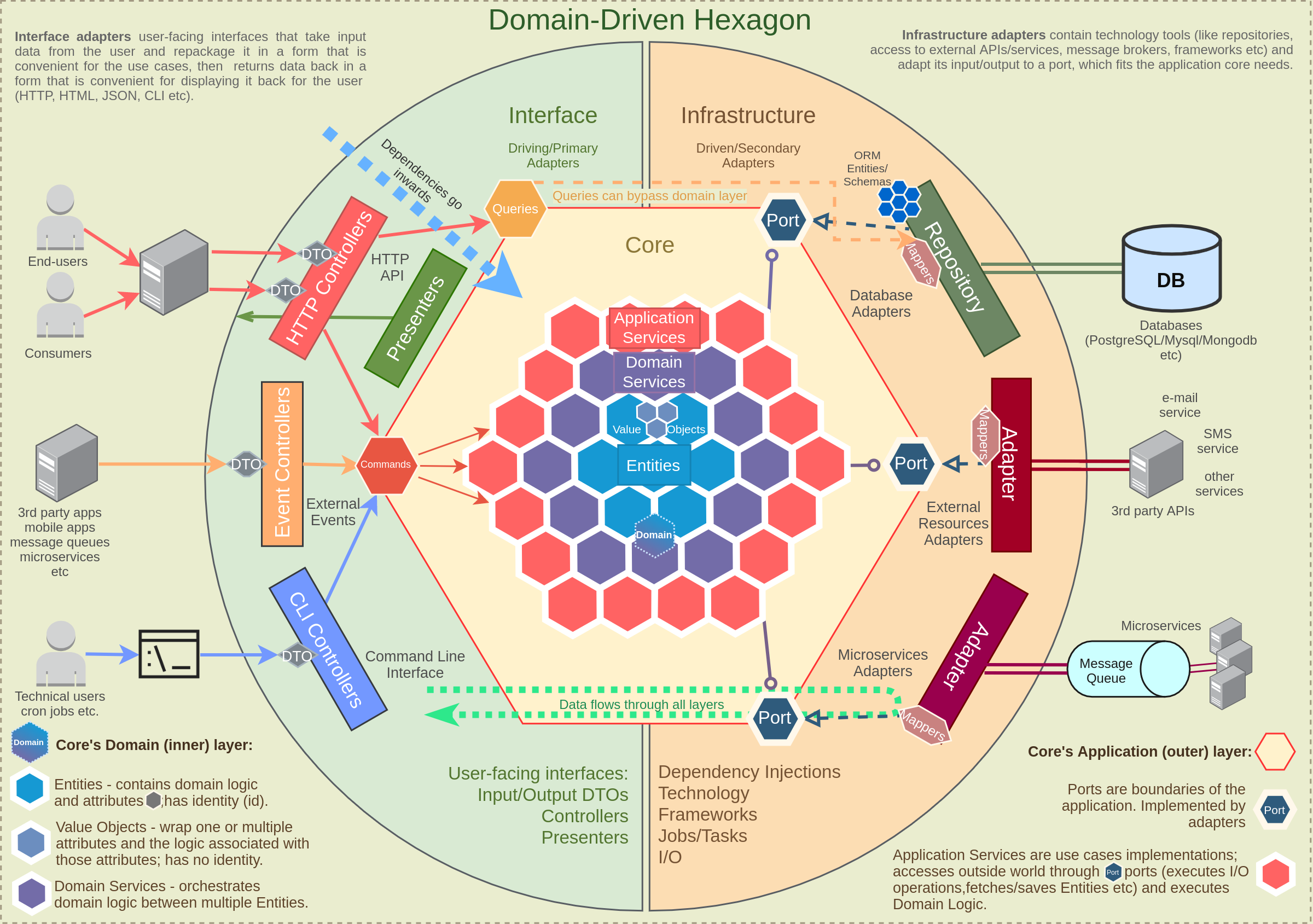
🎯 Layer Mapping
-
Domain Layer
Contains Entities, Value Objects, Aggregates, Domain Events, and Domain Services. -
Application Layer
Contains Application Services orchestrating use cases and transaction management. -
Infrastructure Layer
Contains technical details: databases, external APIs, messaging systems. -
Presentation Layer
Handles user interfaces, API controllers, GraphQL endpoints.
📚 Best Practices for DDD + Clean Architecture
✅ Core Domain Independence
No domain object should reference frameworks, ORMs, or infrastructure.
✅ Dependency Rule
Only the outer layers depend on the inner layers — never the other way around.
✅ Use Dependency Injection
Inject dependencies at runtime — domain classes have no compile-time knowledge of infrastructure.
✅ Interface Segregation
Define infrastructure abstractions (e.g., IOrderRepository) inside the domain/application layers.
✅ Test Domain Layers in Isolation
Pure domain logic can be unit tested without any infrastructure setup.
🧩 ConnectSoft Example: Layered Clean Architecture
flowchart TD
    subgraph Domain Layer
        Aggregates
        Entities
        ValueObjects
        DomainEvents
    end

    subgraph Application Layer
        ApplicationServices
        UseCases
    end

    subgraph Infrastructure Layer
        DatabaseAdapters
        MessagingAdapters
        ExternalAPIs
    end

    subgraph Presentation Layer
        RESTControllers
        GraphQLHandlers
        UIs
    end

    Aggregates --> ApplicationServices
    Entities --> ApplicationServices
    ValueObjects --> ApplicationServices
    DomainEvents --> ApplicationServices
    ApplicationServices --> DatabaseAdapters
    ApplicationServices --> MessagingAdapters
    ApplicationServices --> ExternalAPIs
    RESTControllers --> ApplicationServices
    GraphQLHandlers --> ApplicationServices
UIs --> RESTControllers✅ Pure layering.
✅ Independence preserved.
✅ Models evolve freely even if technologies change.
🚀 ConnectSoft Strategic Position
At ConnectSoft:
- Every Microservice is a Bounded Context, a Clean Architecture, and an Event-Driven Service.
- Strategic and Tactical DDD are mandatory standards.
- Microservices communicate using events first, APIs second.
- The domain model is respected as the system's foundation, not an afterthought.
Conclusion
At ConnectSoft, Domain-Driven Design (DDD) is not just a methodology —
it is a core architectural philosophy that shapes every SaaS platform, microservice, AI-powered workflow, and cloud-native solution we build.
By adhering to DDD principles:
- Systems model real-world business capabilities precisely.
- Microservices boundaries are clearly defined and respected.
- Changes can be absorbed safely through strong bounded contexts.
- Event-driven designs naturally emerge, enhancing scalability and resilience.
- Teams collaborate better through a shared ubiquitous language.
- Software remains aligned with evolving business needs — not frozen by technical debt.
Strategic design, tactical mastery, and event-driven architecture converge at ConnectSoft to deliver systems that are:
- Scalable in the face of massive growth,
- Flexible to adapt to change,
- Reliable even under heavy load,
- Understandable by business and technical stakeholders alike,
- Maintainable over years of continuous evolution.
Every bounded context, every aggregate, every repository, and every domain event plays a role in reinforcing a unified, resilient, and agile platform —
designed for the real world, at real scale.
DDD at ConnectSoft is not a theory.
It is our operational DNA.
It is how we deliver the future.
References
-
Books and Literature
- Eric Evans — Domain-Driven Design: Tackling Complexity in the Heart of Software
- Vaughn Vernon — Implementing Domain-Driven Design
- Jimmy Nilsson — Applying Domain-Driven Design and Patterns
-
Online Resources
-
DDD Community and Blogs
-
Internal ConnectSoft References
- ConnectSoft Architecture Standards - TBD (Internal)
- ConnectSoft Microservices Blueprint - TBD (Internal)
- ConnectSoft AI-Driven DDD Patterns - TBD (Internal)